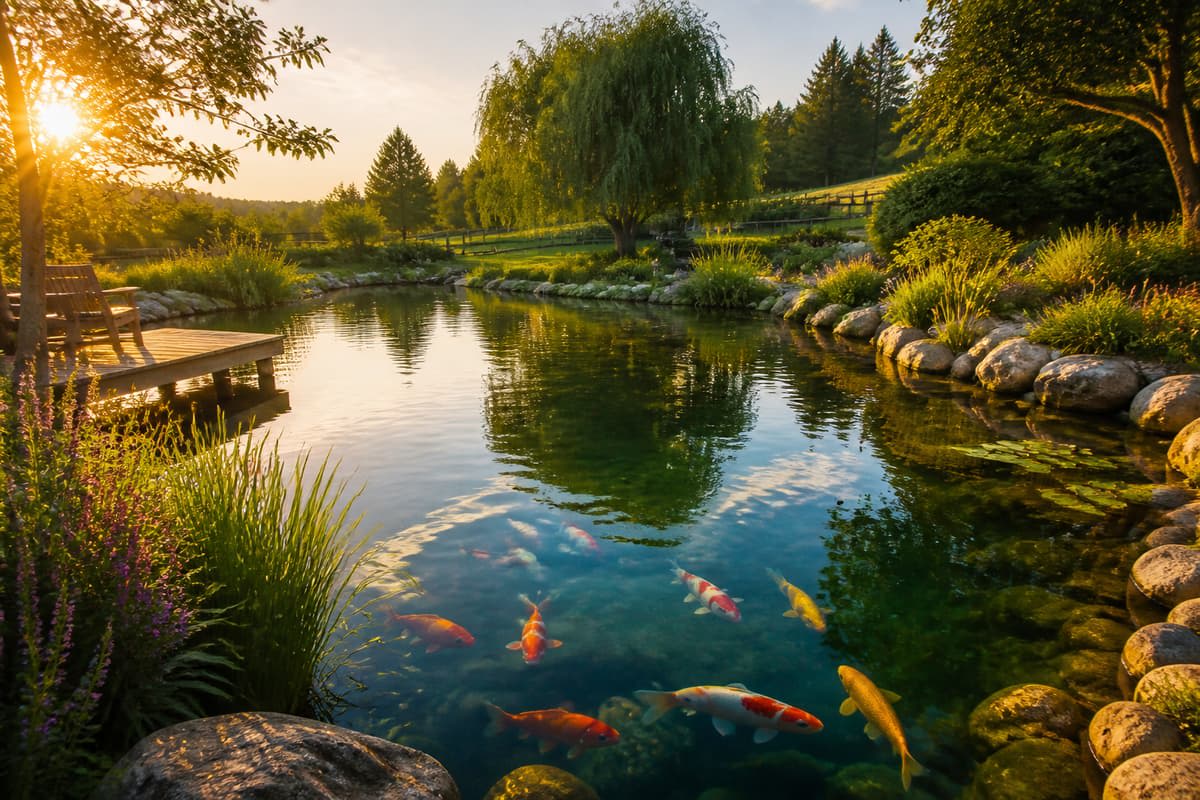
How much does it cost to stock a pond?
How much does it cost to stock a pond?
$250 – $850 average total cost
$400 – $600 per acre (basic stocking)
$800 – $1,000 per acre (full package)

Stocking a pond with fish is one of the most rewarding investments a landowner can make, whether the goal is recreational bass fishing, panfish for the dinner table, or simply creating a balanced aquatic ecosystem. The cost to stock a pond typically ranges from $250 to $850+ for most private ponds between a quarter acre and one acre. Your total cost depends on pond size, fish species, quantity, and fish size at the time of purchase. This guide breaks down every cost you need to know before placing your first fish order.
Average cost to stock a pond
Most pond owners spend between $250 and $850 to fully stock a pond with a balanced mix of sport fish, panfish, forage minnows, and vegetation control species. A basic stocking of just bass and bluegill for a one-acre pond can cost as little as $250 to $400, while a comprehensive package with six or more species runs $700 to $1,000+.
| Pond Size | Basic Stocking Cost | Full Package Cost |
|---|---|---|
| 1/4 acre | $100 – $175 | $225 – $300 |
| 1/2 acre | $200 – $325 | $450 – $550 |
| 3/4 acre | $300 – $475 | $650 – $800 |
| 1 acre | $400 – $600 | $800 – $1,000+ |
These prices reflect fingerling-size fish (2 to 4 inches), which is the most cost-effective size to stock. Larger fish cost significantly more per unit but give you a head start on a fishable pond. Delivery fees, permits, and supplemental items like fish food or pond conditioners add to the total.
Cost by fish species
Individual fish prices vary widely based on species and size. Fingerlings in the 2- to 4-inch range are the least expensive option. Larger fish that are closer to catchable size can cost 5 to 10 times more per fish. Below is a breakdown of the most commonly stocked species and their typical prices.
| Species | Size | Price Per Fish |
|---|---|---|
| Largemouth bass | 2 – 4 inches | $1.30 – $1.50 |
| Largemouth bass | 4 – 6 inches | $2.50 – $3.00 |
| Largemouth bass | 6 – 8 inches | $6.00 – $8.00 |
| Largemouth bass | 8 – 10 inches | $9.00 – $11.00 |
| Largemouth bass | 10 – 12 inches | $12.00 – $15.00 |
| Bluegill | 2 – 4 inches | $1.00 – $1.25 |
| Bluegill | 4 – 6 inches | $2.00 – $2.50 |
| Bluegill | 6 – 8 inches | $4.50 – $5.00 |
| Hybrid bluegill | 2 – 4 inches | $1.00 – $1.25 |
| Hybrid bluegill | 4 – 6 inches | $2.25 – $2.75 |
| Channel catfish | 4 – 6 inches | $0.75 – $1.00 |
| Channel catfish | 6 – 8 inches | $1.75 – $2.25 |
| Channel catfish | 8 – 10 inches | $2.75 – $3.25 |
| Yellow perch | 2 – 4 inches | $1.00 – $1.25 |
| Yellow perch | 4 – 6 inches | $2.00 – $2.50 |
| Redear sunfish (shellcracker) | 2 – 4 inches | $1.00 – $1.25 |
| Redear sunfish (shellcracker) | 4 – 6 inches | $2.25 – $2.75 |
| Black crappie | 2 – 4 inches | $1.00 – $1.25 |
| Black crappie | 4 – 6 inches | $2.50 – $3.00 |
| Rainbow trout | Various | $6.50 – $7.50 |
| Triploid grass carp (amur) | 10 – 12 inches | $15.00 – $18.00 |
| Fathead minnows | 1 – 3 inches | $0.08 – $0.10 each |
| Fathead minnows | Per pound (bulk) | $13.00 – $14.00 |
Let's take a closer look at each of the most popular species and what you can expect to pay.
Largemouth bass
Largemouth bass are the cornerstone of most sport-fishing ponds. Fingerlings (2 to 4 inches) cost about $1.30 to $1.50 each, making them affordable even in large quantities. The price climbs steeply as size increases; a 10- to 12-inch bass costs around $12 to $15 each. Fish over 12 inches are typically sold by the pound at roughly $18 per pound.
Most pond managers recommend stocking bass at least one full year after forage fish are established so the bass have an immediate food source upon introduction.
Bluegill and hybrid bluegill
Bluegill serve double duty as both a popular panfish and the primary forage base for largemouth bass. Standard bluegill fingerlings cost $1.00 to $1.25 each. Hybrid bluegill cost about the same at the fingerling stage but grow larger and faster than standard bluegill.
One important distinction: roughly 90% of hybrid bluegill offspring are male, which reduces the risk of overpopulation in small ponds. However, hybrids lose their size advantage within a generation, so plan on restocking a portion every few years.
Channel catfish
Channel catfish are one of the most affordable species to stock, starting at $0.75 to $1.00 each for 4- to 6-inch fingerlings. Adult catfish sell for about $5.00 per pound. Catfish are a popular addition for pond owners who want a reliable eating fish alongside their bass and bluegill populations.
Rainbow trout
Trout are a premium stocking option at $6.50 to $7.50 each. Volume discounts are common; orders of 100 or more fish often bring the per-fish price to the lower end. Trout require cold, well-oxygenated water, so they are not a practical year-round option in many warm-climate ponds.
Cost by pond size
Pond stocking costs scale linearly with surface acreage. A one-acre pond requires roughly four times the fish of a quarter-acre pond. The table below shows typical total costs for comprehensive stocking packages that include bass, bluegill, hybrid bluegill, shellcracker, perch, minnows, and grass carp.
| Pond Size | Fish Included (Typical Package) | Total Package Cost |
|---|---|---|
| 1/4 acre | 25 bass, 50 bluegill, 25 hybrid bluegill, 25 shellcracker, 25 perch, 250 minnows, 2 grass carp | $225 – $275 |
| 1/2 acre | 50 bass, 100 bluegill, 50 hybrid bluegill, 50 shellcracker, 50 perch, 500 minnows, 4 grass carp | $450 – $500 |
| 3/4 acre | 75 bass, 150 bluegill, 75 hybrid bluegill, 75 shellcracker, 75 perch, 750 minnows, 6 grass carp | $675 – $725 |
| 1 acre | 100 bass, 200 bluegill, 100 hybrid bluegill, 100 shellcracker, 100 perch, 1,000 minnows, 8 grass carp | $800 – $900 |
Many hatcheries offer volume discounts for larger orders. A one-acre package often has lower per-fish prices than the quarter-acre package. For example, fingerling bass may drop from $1.40 to $1.30 each at higher quantities, and bluegill from $1.10 to $1.00 each.
Ponds larger than one acre follow the same proportional scaling. A two-acre pond would roughly double the one-acre quantities and cost. For ponds five acres or larger, many hatcheries provide custom quotes and may offer additional discounts.
Pond stocking packages
Purchasing a pre-designed stocking package from a hatchery is the simplest and often most economical way to stock a pond. Packages bundle the right species in the right ratios, typically costing 10% to 15% less than buying each species individually.
| Package Type | Species Included | Typical Cost (1 Acre) |
|---|---|---|
| Basic bass and bluegill | Largemouth bass, bluegill, fathead minnows | $300 – $450 |
| Sport fishing package | Bass, bluegill, hybrid bluegill, shellcracker, catfish, minnows | $550 – $750 |
| Comprehensive package | Bass, bluegill, hybrid bluegill, shellcracker, perch, minnows, grass carp | $800 – $1,000 |
| Trophy bass package | Larger bass (6 – 8 inches), extra bluegill, minnows, supplemental feed | $1,200 – $2,000+ |
Many hatcheries also include a pond management book or guide with their packages, which is worth the typical $20 cost for first-time pond owners. Some packages can be customized by swapping species or adjusting quantities to suit specific goals.
Recommended stocking rates per acre
Getting the right number of fish per acre is critical for building a balanced pond ecosystem. Understocking leaves your pond underutilized, while overstocking leads to stunted fish and poor water quality. The rates below apply to new ponds with no existing fish populations.
| Species | No Supplements | Supplemented (Feed/Fertilizer) |
|---|---|---|
| Largemouth bass | 50 – 100 fish per acre | 100 – 200 fish per acre |
| Northern bluegill | 500 – 1,000 fish per acre | 1,000 – 2,000 fish per acre |
| Redear sunfish (optional) | 150 fish per acre | 200 fish per acre |
| Channel catfish (optional) | 100 fish per acre | 300 fish per acre |
| Black crappie (optional) | 50 fish per acre | 100 fish per acre |
| Fathead minnows (forage) | 10 – 20 lbs per acre | 10 – 20 lbs per acre |
The bluegill-to-bass ratio is the most important number to get right. Most pond management experts recommend stocking roughly 10 bluegill for every 1 bass. This ratio ensures bass have a sufficient forage base while keeping the bluegill population from exploding.
A "supplemented" pond is one where the owner feeds fish food pellets, fertilizes the water to boost plankton growth, or both. These ponds can support roughly twice as many fish per acre because the food chain is artificially boosted.
Low-end vs. high-end stocking rates
Stocking at the low end of the range produces fewer but larger fish because competition for food is reduced. This approach is ideal for pond owners who want to grow trophy-size bass exceeding 8 pounds.
Stocking at the high end provides more fishing action and quicker catches but typically results in smaller average fish size. For ponds focused on family recreation rather than trophy fishing, higher stocking rates often make more sense.
Factors that affect stocking costs
The final price tag for stocking a pond goes beyond fish prices alone. Several variables can push your total cost higher or bring it down significantly.
| Factor | Impact on Cost |
|---|---|
| Fish size at stocking | Larger fish cost 3x to 10x more than fingerlings |
| Delivery fees | $50 – $200+ depending on distance |
| Pond size | Costs scale proportionally with acreage |
| Number of species | More species increases total cost |
| Permits (grass carp) | $10 – $50 in states that require them |
| Sales tax | Up to 7.75% depending on your state |
| Seasonal availability | Fall-only species like walleye and pike may cost more |
| Supplements (feed, fertilizer) | $90 – $400+ per year |
Fish size
This is the single biggest cost variable. A 2- to 4-inch bass costs about $1.40, while an 8- to 10-inch bass costs $10.00. If you want to skip the wait for fish to grow, expect to pay significantly more. Stocking 100 fingerling bass costs around $130 to $140, while stocking 100 fish in the 8- to 10-inch range would cost approximately $1,000.
Delivery fees
Some hatcheries deliver directly to your pond via fish trucks, while others operate through a network of "fish day" pickup locations across multiple states. Direct delivery to your property costs $50 to $200+ depending on distance. Fish day pickups are often free or carry a minimal fee.
Permits and regulations
Triploid grass carp require permits in many states, and some states ban them entirely. Always check with your state wildlife agency before ordering grass carp or any non-native species. Permit fees are typically modest at $10 to $50, but fines for stocking without one can be severe.
Forage fish costs
Fathead minnows are the primary forage fish used to establish a food chain before stocking predator species. They cost $8 to $10 per hundred or $65 to $80 per thousand. Bulk purchases of 50 pounds or more bring the price down to about $13 to $14 per pound.
| Quantity | Price |
|---|---|
| Per 100 fish | $8.00 – $10.00 |
| Per 1,000 fish | $65.00 – $80.00 |
| Per pound (50 – 100 lbs) | $13.00 – $14.00 |
| Per pound (100+ lbs) | $12.00 – $13.00 |
Forage fish should be stocked first, ideally in the fall or early spring before bass are introduced. This gives minnows time to reproduce and establish a sustainable food source. Most experts recommend 10 to 20 pounds of fathead minnows per acre as a starting point.
Vegetation control costs
Triploid grass carp (also called white amur) are the most common biological solution for controlling aquatic weeds. They cost $15 to $18 each at 10 to 12 inches and are typically stocked at a rate of about 8 to 10 fish per acre.
| Item | Cost |
|---|---|
| Triploid grass carp (per fish) | $15.00 – $18.00 |
| Grass carp for 1 acre (8 fish) | $120.00 – $144.00 |
| Pond conditioner (1 gallon) | $85.00 – $95.00 |
| Pond conditioner (5 gallons) | $375.00 – $425.00 |
Grass carp are sterile (triploid), which means they will not reproduce in your pond. They can live for 10 years or more and will need to be restocked periodically as the population declines naturally. Several states either ban grass carp or require a stocking permit, so verify local regulations before purchasing.
Pond conditioners and muck reducers are another option for improving water quality. These biological treatments typically cost $85 to $95 per gallon, with one gallon treating most ponds under one acre.
Pond stocking tips to save money
A few smart decisions during the planning stage can cut your stocking costs significantly while setting your pond up for long-term success.
- Stock fingerlings, not adults. Buying 2- to 4-inch fish saves 50% to 90% compared to larger sizes. You will wait a bit longer for catchable fish, but the savings are substantial.
- Buy stocking packages. Pre-bundled packages from hatcheries cost 10% to 15% less than buying each species separately and take the guesswork out of species ratios.
- Stock forage fish first. Introducing minnows and bluegill in the fall, then adding bass the following spring, gives forage species time to reproduce. This natural food production reduces the need for expensive supplemental feed.
- Use fish day pickup locations. Many hatcheries operate seasonal pickup events across 20+ states. Picking up your fish at a nearby location eliminates delivery fees of $50 to $200.
- Avoid crappie in small ponds. Crappie spawn heavily and unpredictably, often overpopulating ponds under 3 acres. This creates stunted fish and can require draining and restocking the entire pond.
- Start with fewer species. A simple bass and bluegill combination is the most forgiving and affordable foundation. You can always add catfish, perch, or shellcracker later.
- Check for state stocking programs. Some state fish and wildlife agencies offer free or subsidized fish for qualifying farm ponds.
Frequently asked questions
How much does it cost to stock a 1-acre pond?
A basic stocking of largemouth bass and bluegill for a one-acre pond costs $300 to $450. A comprehensive package with six or more species, including bass, bluegill, hybrid bluegill, shellcracker, perch, minnows, and grass carp, costs $800 to $1,000. Using fingerlings (2 to 4 inches) rather than larger fish keeps costs at the lower end.
What fish should I stock first?
Stock forage fish first. Fathead minnows and bluegill should go into a new pond in the fall or early spring. Wait at least 6 to 12 months before introducing largemouth bass so the forage population has time to reproduce. Adding bass to a pond without an established food chain is the most common mistake new pond owners make.
How many fish do I need per acre?
A standard unsupplemented pond needs about 50 to 100 bass and 500 to 1,000 bluegill per acre. The target ratio is roughly 10 bluegill for every bass. Supplementing with fish food or fertilizing the water can allow you to double those numbers.
Should I stock crappie in my pond?
In most cases, no. Crappie spawn heavily and overpopulate quickly, especially in ponds smaller than 3 acres. Once the population gets out of control, the only reliable fix is draining the pond and starting over. Experienced pond managers can make crappie work in larger ponds (5+ acres), but beginners should avoid them.
How long until I can fish a newly stocked pond?
Most experts recommend waiting 2 to 3 years before fishing a newly stocked pond. This gives the fish population time to grow and reproduce. Light catch-and-release fishing for bluegill can begin sooner, but bass should generally be left alone for the first few years to establish a strong breeding population.
Do hatcheries deliver fish to my pond?
Yes, most hatcheries offer direct delivery via specialized fish trucks. Delivery fees range from $50 to $200+ depending on your distance from the hatchery. Many hatcheries also host seasonal "fish day" events at pickup locations across multiple states, where you can collect your order at little to no delivery cost.
Do I need a permit for grass carp?
In many states, yes. Triploid grass carp are regulated because of their impact on aquatic vegetation. Some states require a simple permit costing $10 to $50, while others ban grass carp entirely. Contact your state fish and wildlife agency or ask your hatchery for guidance before ordering.
When is the best time to stock a pond?
Fall is the ideal time to stock forage fish like minnows and bluegill because cooler water reduces stress during transport and acclimation. Spring is the best time to add bass and catfish. Some species, like walleye, northern pike, and tiger muskies, are only available in the fall and must be reserved in advance.