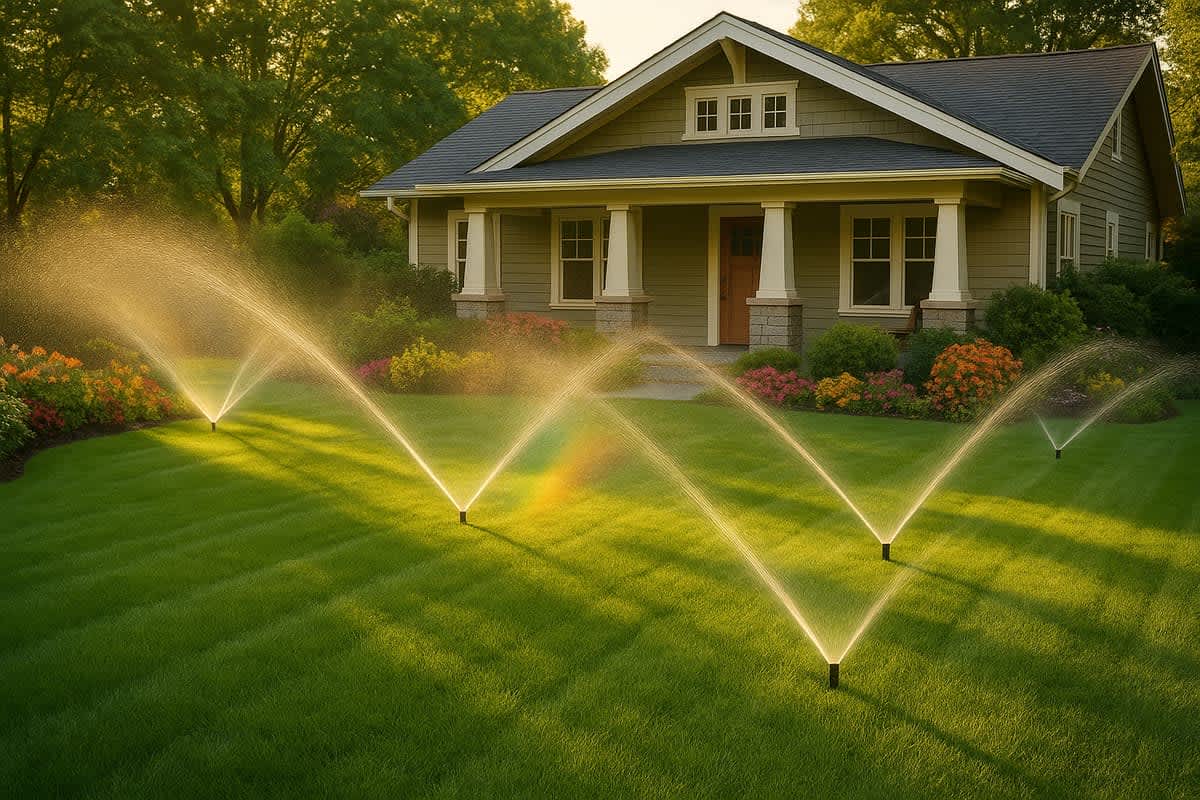
How much does sprinkler system installation cost?
How much does sprinkler system installation cost?
$0.88 – $1.65 per square foot
$2,340 – $9,340 average total cost
$590 – $1,340 per zone

Average Sprinkler System Installation Cost
Installing an automatic in-ground sprinkler system costs most homeowners between $0.88 and $1.65 per square foot of yard, including both materials and labor. For a typical quarter-acre lot, that translates to roughly $2,340 to $9,340 depending on the number of watering zones, sprinkler head types, soil conditions, and your local cost of living.
Some irrigation contractors price their work per watering zone rather than per square foot. On a per-zone basis, expect to pay $590 to $1,340 per zone, with the average residential yard requiring four to seven zones.
| Cost Metric | Average Cost |
|---|---|
| Per square foot (materials and labor) | $0.88 – $1.65 |
| Per watering zone | $590 – $1,340 |
| Typical quarter-acre yard (4–7 zones) | $2,340 – $9,340 |
| Labor rate per hour | $50 – $100 |
Understanding what drives these costs will help you budget accurately and avoid surprises. Below, we break down pricing by yard size, number of zones, sprinkler head type, location, and more.
Sprinkler System Cost by Yard Size
Yard size is the single biggest factor in sprinkler system pricing because larger lawns require more pipe, more sprinkler heads, and more labor hours to trench and install. At $0.88 to $1.65 per square foot, costs scale roughly in proportion to your yard's total irrigated area.
| Yard Size (Square Feet) | Average Installation Cost |
|---|---|
| 1,000 sq ft | $880 – $1,650 |
| 3,000 sq ft | $2,640 – $4,950 |
| 5,000 sq ft | $4,400 – $8,250 |
| 7,000 sq ft | $6,160 – $11,550 |
| 10,000 sq ft | $8,800 – $16,500 |
Larger properties sometimes benefit from volume efficiencies, where the per-square-foot rate drops slightly once the contractor has equipment on-site. However, complex landscaping with garden beds, walkways, and slopes can push costs toward the higher end regardless of total area.
Cost by Number of Watering Zones
A watering zone is a section of your irrigation system connected to a single valve that operates independently and can be programmed on its own schedule. More zones mean more valves, more wire, and more controller capacity, all of which add cost.
| Number of Zones | Average Installation Cost |
|---|---|
| 1 zone | $590 – $1,340 |
| 2 zones | $1,170 – $2,670 |
| 3 zones | $1,880 – $5,000 |
| 4 zones | $2,340 – $5,670 |
| 5 zones | $3,130 – $8,000 |
| 6 zones | $3,500 – $8,170 |
| 7 zones | $4,090 – $9,340 |
The typical quarter-acre residential yard needs 4 to 7 zones. The exact number depends on several factors:
- Yard layout: Narrow side yards, irregularly shaped lots, and separated front and back lawns each need their own zones.
- Slopes and sun exposure: Hillside areas and heavily shaded sections have different watering needs than flat, sunny turf.
- Plant types: Grouping plants with similar water requirements (called hydrozoning) often creates additional zones but saves water long term.
- Water pressure: Limited municipal water pressure may force the system to run fewer heads per zone, increasing the total zone count.
Cost of Sprinkler Heads by Type
Sprinkler heads are the visible part of the system, and the type you choose affects both performance and price. Each watering zone typically uses 5 to 9 heads of the same type. Choosing the right head depends on your lawn's size, shape, water pressure, and the plants you need to irrigate.
| Sprinkler Head Type | Cost per Head | Best Application |
|---|---|---|
| Bubbler | $1.50 – $15 | Tree rings, shrubs, container plants |
| Misting / micro-sprinkler | $3 – $13 | Delicate plants, seedbeds, greenhouses |
| Pop-up | $3 – $15 | Residential lawns, areas where appearance matters |
| Rotary | $5.50 – $20 | Slopes, clay soils, water conservation areas |
| Fixed / stationary | $7.50 – $33.50 | Small lawns, garden beds, uniform areas |
| Gear-driven | $10 – $40 | Medium to large lawns, curving landscapes |
| Impact | $20 – $35 | Large open lawns |
Pop-up heads are the most popular choice for residential lawns because they retract flush with the ground when not in use, keeping your yard looking clean. Gear-driven rotors are ideal for larger zones because they throw water farther and more evenly than fixed heads.
Avoid mixing head types within a single zone. Different sprinkler head types have different precipitation rates. Mixing them on one zone leads to overwatering in some spots and underwatering in others. Use a dedicated zone for each head type.
Sprinkler Installation Cost by Location
Where you live significantly influences your total installation cost. Two factors drive regional price differences: local labor rates and soil type. Rocky or clay-heavy soils cost more to trench through, and contractors in high cost-of-living areas charge higher hourly rates (typically $50 to $100 per hour).
| City | Average Cost per Sq Ft (Materials + Labor) |
|---|---|
| Raleigh, NC | $0.79 – $1.46 |
| Atlanta, GA | $0.82 – $1.52 |
| Missoula, MT | $0.83 – $1.55 |
| Phoenix, AZ | $0.85 – $1.58 |
| Boise, ID | $0.87 – $1.62 |
| Portland, ME | $0.88 – $1.64 |
| Colorado Springs, CO | $0.88 – $1.64 |
| Detroit, MI | $0.90 – $1.68 |
| Madison, WI | $0.91 – $1.70 |
| Las Vegas, NV | $0.94 – $1.76 |
| Boston, MA | $1.02 – $1.95 |
Southeast cities like Raleigh and Atlanta tend to be the most affordable thanks to softer soils and lower labor rates. Northeast metro areas like Boston are consistently among the most expensive.
Labor and Permit Costs
Labor typically accounts for about 50% of the total sprinkler system installation cost. Irrigation contractors charge $50 to $100 per hour, and a full installation on a quarter-acre lot usually takes a crew one to three days.
| Cost Component | Average Cost |
|---|---|
| Labor (per hour) | $50 – $100 |
| Irrigation permit | $50 – $250 |
| Backflow preventer (if required) | $100 – $300 |
| Utility line locating (811 service) | Free |
Many municipalities require a permit before you can connect a sprinkler system to your home's water supply. Permit fees are typically $50 to $250. Your local code may also mandate a backflow prevention device, which adds $100 to $300 to the project.
Call 811 before any digging. Before installation begins, you or your contractor must call 811 to have underground utility lines marked. This service is free and is required by law in all 50 states. Hitting a gas, water, or electrical line can be dangerous and expensive.
Cost of Smart Sensors and Controllers
Adding smart technology to your sprinkler system conserves water and can lower your monthly water bill. Rain sensors, soil moisture sensors, and Wi-Fi-enabled controllers are the most common upgrades.
| Add-On | Average Cost |
|---|---|
| Rain sensor | $20 – $75 |
| Soil moisture sensor | $25 – $100 |
| Basic timer/controller | $30 – $100 |
| Wi-Fi smart controller | $100 – $300 |
| Weather-based (ET) controller | $150 – $350 |
A rain sensor automatically shuts off the system during rainfall, preventing waste. It is one of the cheapest and most effective add-ons. Wi-Fi smart controllers let you manage watering schedules from your phone and can adjust automatically based on local weather data.
Many water districts offer rebates for installing smart irrigation controllers or rain sensors. Check with your local utility before purchasing to see if you qualify.
DIY vs. Professional Installation
A DIY sprinkler system kit costs roughly $0.05 to $0.14 per square foot in materials, a fraction of what professional installation runs. However, DIY kits are designed as above-ground systems that connect to an outdoor faucet and typically cover only about 1,500 square feet.
| Installation Method | Cost per Square Foot | Coverage |
|---|---|---|
| DIY kit (above-ground) | $0.05 – $0.14 | Up to 1,500 sq ft |
| Professional in-ground system | $0.88 – $1.65 | Unlimited (zone-based) |
While the savings are tempting, DIY kits come with significant trade-offs:
- Limited expandability: Most kits are not designed to add zones later.
- Inconsistent coverage: Above-ground hoses and heads are less precise than buried, pressure-regulated systems.
- Risk of damage: Digging without professional knowledge can damage utility lines, and improper connections may cause leaks or code violations.
- No warranty on labor: If something goes wrong, you are responsible for diagnosing and fixing it.
Professional installation costs more upfront, but you get a custom-designed system with proper pressure balancing, code-compliant backflow prevention, and typically a one- to two-year warranty on labor.
Drip Irrigation vs. Traditional Sprinklers
Not every area of your yard needs overhead sprinkler heads. Drip irrigation is an alternative that delivers water directly to plant roots through low-pressure tubing and emitters. It is best suited for garden beds, hedgerows, and landscaped areas rather than open turf.
| System Type | Cost per Square Foot | Best For |
|---|---|---|
| Traditional in-ground sprinkler | $0.88 – $1.65 | Lawns, large turf areas |
| Drip irrigation | $0.50 – $1.20 | Garden beds, trees, shrubs, slopes |
Drip systems use 30% to 50% less water than traditional sprinklers because they minimize evaporation and runoff. Many homeowners combine both: sprinkler zones for the lawn and drip zones for planting beds. Your installer can integrate both types into a single controller.
Factors That Affect Installation Cost
Beyond yard size and zone count, several other variables influence how much you will pay. Here is a summary of the most common cost factors and how they impact the final price.
| Factor | Impact on Cost |
|---|---|
| Soil type (sandy, clay, rocky) | Rocky soil increases trenching time and cost by 20% to 40% |
| Yard slope and grading | Sloped yards need pressure regulation and specialized heads |
| Existing landscaping | Mature trees, hardscaping, and gardens require careful routing |
| Water pressure | Low pressure may require a booster pump ($200 to $600) |
| Backflow preventer | Required by most codes; adds $100 to $300 |
| Winterization needs | Cold climates require blowout valves and annual winterization |
| Controller and sensor upgrades | Smart controllers add $100 to $350 |
Soil and terrain
Sandy or loamy soil is the easiest and cheapest to trench through. Clay soil is harder to dig but retains water well, which may reduce the number of heads needed. Rocky or compacted soil can increase labor costs by 20% to 40% because specialized equipment may be required.
Water pressure
Your home's water pressure determines how many sprinkler heads can run simultaneously on a single zone. If your pressure is below 40 PSI, you may need a booster pump, which costs $200 to $600 installed. Low pressure also typically means more zones, since fewer heads can operate at once.
Winterization
If you live in a climate where temperatures drop below freezing, your system will need to be winterized each fall. This involves blowing compressed air through the pipes to remove all water. Professional winterization costs $50 to $150 per visit annually and is essential to prevent cracked pipes and damaged valves.
Ongoing Maintenance Costs
A sprinkler system is not a set-it-and-forget-it investment. Annual maintenance keeps the system running efficiently and extends its lifespan, which is typically 15 to 20 years for quality components.
| Maintenance Task | Average Annual Cost |
|---|---|
| Spring startup and inspection | $50 – $150 |
| Fall winterization (blowout) | $50 – $150 |
| Sprinkler head replacement | $3 – $40 per head |
| Valve repair or replacement | $75 – $200 per valve |
| Controller reprogramming | $50 – $100 |
Most irrigation professionals offer seasonal service packages that bundle spring startup and fall winterization for $100 to $250 per year. Signing up for a service plan is typically cheaper than booking each visit separately.
How to Save Money on Sprinkler Installation
Sprinkler system installation is a significant investment, but there are practical ways to reduce costs without sacrificing quality:
- Get multiple quotes: Collect at least three bids from licensed irrigation contractors. Prices can vary by 20% to 30% between companies in the same area.
- Install in the off-season: Fall and late winter are slower periods for irrigation contractors, and many offer discounts during these months.
- Start with fewer zones: If budget is tight, install the most important zones first (the front yard, for example) and add zones later.
- Use water-efficient heads: Rotary nozzles and gear-driven heads distribute water more evenly and reduce waste, lowering your water bill over time.
- Check for rebates: Many water utilities offer rebates of $50 to $200 for installing smart controllers, rain sensors, or drip irrigation.
- Combine with other landscaping work: If you are already regrading your yard or installing sod, adding sprinkler installation to the same project can save on mobilization and trenching costs.
Frequently Asked Questions
How long does sprinkler system installation take?
A professional crew can install a typical residential sprinkler system in one to three days. Larger properties or complex layouts with many zones may take up to five days. The timeline also depends on soil conditions and whether any hardscaping needs to be worked around.
Does a sprinkler system increase home value?
Yes. Real estate experts estimate that an in-ground sprinkler system can increase a home's value by 5% to 15% of the system's installed cost. More importantly, it makes the property more attractive to buyers, especially in dry climates where manual watering is impractical.
How many sprinkler zones do I need?
The average quarter-acre yard requires 4 to 7 zones. The exact number depends on your water pressure, yard layout, plant types, and sun exposure. Your irrigation contractor will perform a pressure test and design a zone plan before installation begins.
Is a permit required for sprinkler system installation?
Most municipalities require a permit when connecting to the municipal water supply. Permit fees are typically $50 to $250. Your contractor usually handles the permit application as part of the project.
How much water does a sprinkler system use?
A typical residential sprinkler system uses 12 to 17 gallons per minute per zone. Running four zones for 20 minutes each uses roughly 960 to 1,360 gallons per watering session. Smart controllers and rain sensors can reduce total usage by 20% to 40%.
Can I install a sprinkler system myself?
DIY kits are available for $0.05 to $0.14 per square foot, but they are limited to above-ground setups covering about 1,500 square feet. For a permanent in-ground system with multiple zones, professional installation is strongly recommended to ensure proper pressure balancing, code compliance, and utility line safety.