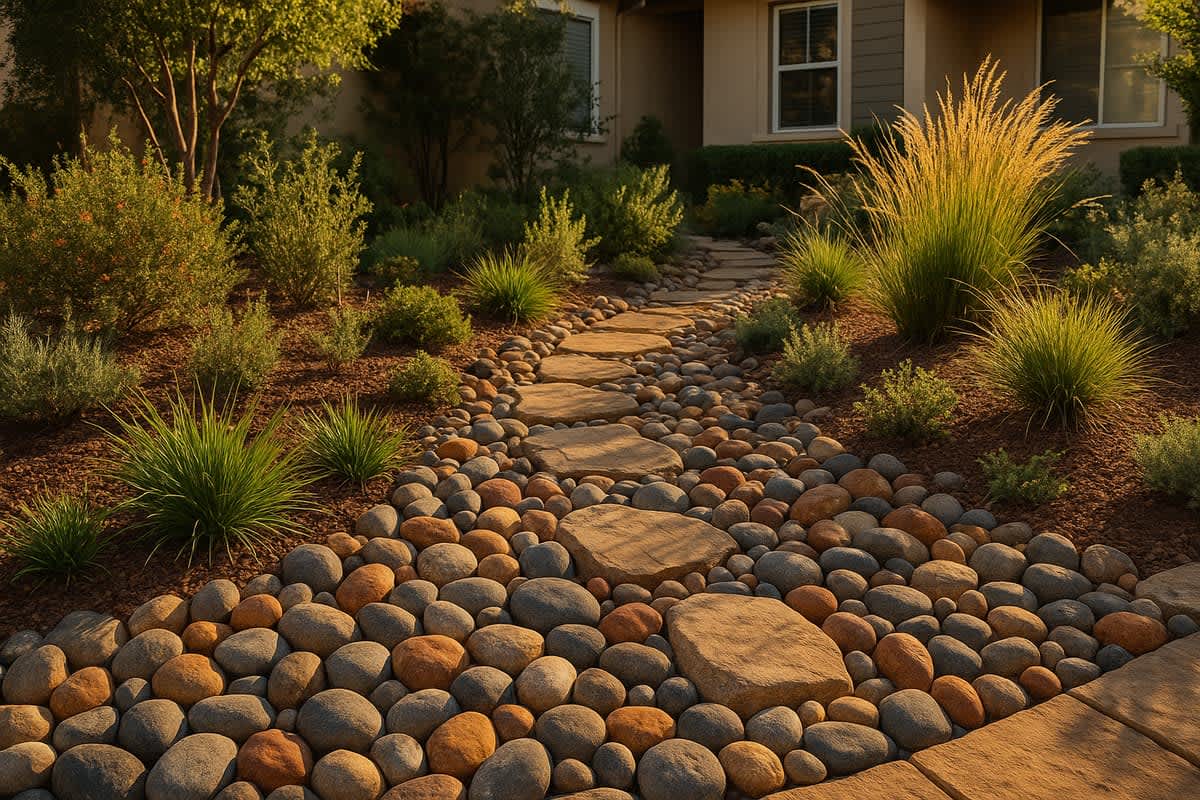
How much does river rock cost?
How much does river rock cost?
$50 – $250 per ton
$3 – $10 per bag
$100 – $800 average total cost

Average river rock prices
River rock typically costs $50 to $250 per ton for bulk purchases and $3 to $10 per bag for small quantities at home improvement stores. The price you pay depends on the rock size, color, quantity, source, and whether delivery is included. For most residential landscaping projects, homeowners spend $100 to $800 total on river rock materials.
| Purchase method | Average cost |
|---|---|
| Per ton (bulk) | $50 – $250 |
| Per cubic yard | $50 – $200 |
| Per bag (0.5 cu ft) | $3 – $10 |
| Per pound | $0.05 – $0.35 |
| Per square foot (installed) | $1 – $5 |
River rock is one of the most popular landscaping materials for gardens, drainage solutions, walkways, and decorative ground cover. Its smooth, rounded appearance adds a natural aesthetic to any outdoor space while serving practical functions like erosion control and weed suppression.
River rock prices by size
Rock size is the single biggest factor affecting river rock pricing. Smaller stones are typically less expensive because they require less processing and handling, while larger stones cost more due to weight, sourcing difficulty, and the specialized equipment needed for placement.
| Rock size | Common uses | Price per ton |
|---|---|---|
| Pea gravel (3/8") | Pathways, fill, drainage | $25 – $80 |
| Small (3/4" – 1") | Ground cover, garden beds | $50 – $150 |
| Medium (1" – 3") | Landscaping, dry creek beds | $75 – $200 |
| Large (3" – 5") | Borders, water features, accents | $100 – $250 |
| Extra large (5" – 12") | Retaining walls, focal points | $100 – $350 |
| Boulders (12"+) | Accent features, erosion control | $75 – $500 |
Small river rock in the 3/4-inch to 1-inch range is the most commonly purchased size for residential landscaping. It works well for ground cover, mulch replacement, and filling in around plants. At many garden centers, small to mid-size river rock starts at around $89.50 per ton.
Medium river rock (1 to 3 inches) is ideal for dry creek beds and drainage swales. This size offers a balance between coverage area and visual impact, making it a popular choice for homeowners looking to create natural-looking water features.
Large and extra-large river rock (3 to 12 inches) costs considerably more per ton but covers less area. These stones are best used as accents, borders, or focal points rather than as broad ground cover.
River rock prices by color
Color plays a significant role in river rock pricing. Common earth tones are the most affordable, while specialty colors and polished stones carry premium price tags. The color you choose should complement your home's exterior and existing landscape design.
| Color/Type | Price per ton |
|---|---|
| Gray/natural mix | $50 – $100 |
| Brown/tan | $50 – $150 |
| White | $75 – $200 |
| Black/charcoal | $100 – $250 |
| Mixed/rainbow | $100 – $250 |
| Red/rust | $100 – $300 |
| Polished/tumbled | $150 – $400 |
Standard gray and brown river rock is the most budget-friendly option because it is abundant and widely available. These neutral tones blend naturally into most landscapes and pair well with greenery.
White river rock offers a clean, modern aesthetic and works well in contemporary landscapes, Zen gardens, and around dark-colored mulch beds. However, white stones tend to show dirt more easily and may require occasional rinsing to maintain their appearance.
Black and red river rocks are specialty options that command higher prices. They are sourced from specific quarries, and availability in your region can significantly affect cost. Polished or tumbled river rock, which has a glossy finish, is the most expensive option and is typically used in small quantities for decorative accents.
Bulk vs. bagged river rock
Buying in bulk saves significantly compared to purchasing individual bags. Bagged river rock from home improvement stores is convenient for small projects but costs three to five times more per ton than bulk delivery from a landscape supply yard.
| Purchase method | Best for | Cost per ton equivalent |
|---|---|---|
| Bulk (by the ton) | Large projects (500+ sq ft) | $50 – $250 |
| Bulk (by the cubic yard) | Mid-size projects (200 – 500 sq ft) | $50 – $200 |
| Bagged (retail store) | Small projects, touch-ups | $200 – $800 |
| Super sack (1/2 – 1 ton) | Mid-size projects, no dump trailer | $75 – $300 |
For any project requiring more than a few hundred pounds of river rock, bulk purchasing is the clear winner. A single 0.5-cubic-foot bag at a home improvement store runs $3 to $10, and you would need roughly 50 to 60 bags to equal one cubic yard. That translates to $150 to $600 in bag costs versus $50 to $200 for the same volume in bulk.
Many landscape supply yards also offer a "super sack" or "tote" option, which is a large woven bag containing about half a ton to one ton of material. This is a good middle ground for homeowners who need more than a few bags but less than a full dump truck load.
One ton of river rock covers approximately 80 to 120 square feet at a 2-inch depth, depending on the stone size. Larger rocks leave more gaps and require more material per square foot than smaller, tightly packing stones.
Delivery costs for river rock
Delivery fees add $50 to $200 or more to your total cost, depending on distance, quantity, and the supplier. Some landscape supply companies include delivery in their per-ton pricing for orders above a certain minimum, while others charge separately.
| Delivery distance | Typical cost |
|---|---|
| Local delivery (under 10 miles) | $50 – $100 |
| Extended delivery (10 – 30 miles) | $100 – $200 |
| Long distance (30+ miles) | $200 – $500 |
| Self-pickup (no delivery) | $0 |
If you have a truck or trailer, picking up river rock yourself from a landscape supply yard is the most cost-effective approach. Many yards will load bulk material with a front loader directly into your vehicle at no extra charge.
For delivery orders, most suppliers require a minimum purchase of one to two tons. The truck will dump the load on your driveway or designated area, and you will need to wheelbarrow and spread the rock yourself unless you also hire labor for installation. Delivery pricing for bulk landscaping materials is similar to what you'd see with topsoil cost estimates, where local deliveries within 10 to 20 miles typically add $50 to $150.
Installation and labor costs
Professional installation of river rock costs $50 to $100 per hour for labor, or $1 to $3 per square foot on top of material costs. Hiring professionals makes sense for large areas, sloped terrain, or projects that involve grading, fabric installation, and edging.
| Service | Average cost |
|---|---|
| Labor per hour | $50 – $100 |
| Labor per square foot | $1 – $3 |
| Landscape fabric | $0.15 – $0.50 per sq ft |
| Edging/borders | $2 – $8 per linear foot |
| Grading/site prep | $500 – $2,000 |
A typical residential project covering 500 square feet with river rock might cost $500 to $1,500 for materials and $500 to $1,500 for professional installation, bringing the total to $1,000 to $3,000.
DIY installation can save you 40% to 60% on total project costs. The work involves clearing the area, laying landscape fabric, installing edging, and spreading the rock to an even depth. While labor-intensive, it does not require specialized skills or tools beyond a wheelbarrow, rake, and shovel.
How much river rock do you need?
Calculating the right amount of river rock prevents costly overages or frustrating shortages. The formula is straightforward: multiply the area's length by width by desired depth, then convert to cubic yards or tons.
| Area (sq ft) | 2-inch depth | 3-inch depth | 4-inch depth |
|---|---|---|---|
| 100 sq ft | 0.6 cubic yards | 0.9 cubic yards | 1.2 cubic yards |
| 200 sq ft | 1.2 cubic yards | 1.9 cubic yards | 2.5 cubic yards |
| 500 sq ft | 3.1 cubic yards | 4.6 cubic yards | 6.2 cubic yards |
| 1,000 sq ft | 6.2 cubic yards | 9.3 cubic yards | 12.3 cubic yards |
One cubic yard of river rock weighs approximately 1.2 to 1.5 tons, depending on the density and moisture content of the stone. When ordering, always add 10% extra to account for settling, uneven ground, and waste.
For decorative ground cover and garden beds, a 2-inch depth is usually sufficient. Drainage applications and dry creek beds typically need 3 to 4 inches of depth to function properly and look natural.
Quick calculation: To cover 100 square feet at a 2-inch depth, you need roughly 0.6 cubic yards or about 3/4 of a ton. At average bulk prices, that costs $50 to $150 for materials alone.
River rock vs. other landscaping materials
River rock is a mid-range landscaping material when compared to alternatives like pea gravel, crushed stone, mulch, and flagstone. Its smooth appearance and durability make it a worthwhile investment for many applications, though other materials may be better suited for certain projects.
| Material | Cost per ton | Lifespan |
|---|---|---|
| Pea gravel | $25 – $60 | Indefinite (may scatter) |
| Crushed stone | $25 – $75 | Indefinite |
| Wood mulch | $20 – $45 per yard | 1 – 3 years |
| River rock | $50 – $250 | Indefinite |
| Decorative stone | $42 – $150 | Indefinite |
| Flagstone | $150 – $700 | Indefinite |
River rock's primary advantage over wood mulch is longevity. While mulch decomposes and needs replacement every one to three years, river rock lasts indefinitely with minimal maintenance. Over a 10-year period, river rock often proves more cost-effective despite higher upfront costs.
Compared to pea gravel and crushed stone, river rock is more expensive but offers a more polished, natural appearance. Crushed stone compacts better and is preferable for driveways and paths with heavy foot traffic, while river rock excels in decorative and drainage applications.
Homeowners considering alternatives to natural ground cover materials may also want to explore artificial grass cost, which eliminates the need for both mulch and rock in lawn areas. For those who prefer a traditional lawn instead, sod prices offer another point of comparison for covering large outdoor spaces.
Decorative landscape rock, such as Gold Rush and Cappuccino varieties available at supply yards, starts at around $42.50 per ton and offers an affordable alternative with more color variety than standard river rock.
Factors that affect river rock prices
Several variables influence the final price you pay for river rock. Understanding these factors helps you make smarter purchasing decisions and find the best value for your project.
| Factor | Impact on price |
|---|---|
| Rock size | Larger stones cost more per ton |
| Color/rarity | Specialty colors add 50% – 200% |
| Quantity ordered | Bulk orders reduce per-ton cost |
| Geographic location | Prices vary by 20% – 50% regionally |
| Distance from quarry | Transportation adds cost |
| Delivery fees | Adds $50 – $200+ |
| Season | Spring/summer demand raises prices |
Geographic location is a major cost driver. Areas close to natural river rock sources, such as riverbeds and quarries, enjoy lower prices. Regions far from these sources pay a premium for transportation. For example, prices in the Southwest and Southeast tend to be lower than in the Northeast.
Seasonality also plays a role. Landscape supply yards are busiest during spring and summer, which can drive up prices and reduce availability. Purchasing river rock in late fall or winter often yields better pricing and faster delivery.
Natural variation is something to keep in mind when budgeting. The crushing and screening process of natural rock products produces variations in size, color, and shape. All natural rock products contain varying amounts of fines (dust and small particles), which slightly reduces the usable volume.
Where to buy river rock
River rock is available from several types of retailers, each with distinct advantages in terms of pricing, selection, and convenience.
- Landscape supply yards offer the best bulk prices, typically $50 to $200 per ton, with the widest selection of sizes and colors. Many allow you to see and touch samples before ordering.
- Home improvement stores (Home Depot, Lowe's) sell bagged river rock for $3 to $10 per bag. This is convenient for small projects but expensive at scale.
- Quarries and gravel pits provide the lowest prices if you are located nearby and willing to pick up the material yourself. Expect to pay $25 to $100 per ton.
- Online retailers sell specialty and decorative river rock, often at higher prices with significant shipping costs due to the material's weight.
- Garden centers carry bulk river rock starting at around $89.50 per ton, with multiple size options and regional pricing.
| Retailer type | Price range | Best for |
|---|---|---|
| Landscape supply yards | $50 – $200 per ton | Large bulk orders, wide selection |
| Home improvement stores | $3 – $10 per bag | Small projects, convenience |
| Quarries/gravel pits | $25 – $100 per ton | Lowest prices, self-pickup |
| Online retailers | Varies (+ shipping) | Specialty and decorative stones |
| Garden centers | $89.50+ per ton | Mid-range pricing, local options |
Always request to see a sample or visit the supply yard in person before placing a large order. River rock color can vary significantly between batches, and online photos may not accurately represent the material you receive.
Common uses for river rock
River rock serves both decorative and functional purposes in residential and commercial landscaping. Its versatility makes it one of the most widely used natural stone products available.
- Garden beds and ground cover: Replaces mulch for a low-maintenance, permanent ground covering that suppresses weeds and retains soil moisture.
- Dry creek beds: Medium to large river rock creates attractive, natural-looking drainage channels that manage water runoff during storms.
- French drains and drainage: River rock's rounded shape allows water to flow freely, making it ideal for drainage applications around foundations and low-lying areas.
- Walkways and pathways: Smaller river rock creates attractive, permeable walking surfaces for gardens and yards.
- Water features and ponds: Lines the edges and bottoms of ponds, fountains, and waterfalls for a natural aesthetic.
- Erosion control: Placed on slopes and hillsides to prevent soil washout during heavy rain.
- Driveway borders and edging: Defines landscape boundaries and adds visual interest along driveways and sidewalks.
River rock landscaping pairs well with ongoing lawn care to keep your entire yard looking polished and well-maintained.
Tips for saving money on river rock
A few smart strategies can reduce your river rock costs by 20% to 50% without sacrificing quality or coverage.
- Buy in bulk from a landscape supply yard instead of purchasing bags from retail stores.
- Pick up the material yourself if you have a truck or trailer to avoid delivery fees.
- Shop in the off-season (fall or winter) when demand is lower and suppliers may offer discounts.
- Get multiple quotes from at least three suppliers, as prices can vary significantly even within the same area.
- Use a base layer of cheaper crushed stone beneath a thinner top layer of decorative river rock to reduce the amount of premium material needed.
- Install landscape fabric before placing rock to prevent stones from sinking into the soil over time, which would require additional material later.
- Check local classifieds for homeowners giving away or selling river rock from demolished landscaping projects at steep discounts.
Frequently asked questions
How many tons of river rock do I need for my project?
For a 2-inch depth, one ton of river rock covers approximately 80 to 120 square feet. Measure your area's length and width in feet, multiply them to get square footage, then divide by 100 for a rough estimate of tons needed. Add 10% extra for settling and waste.
Is river rock cheaper than mulch?
River rock has a higher upfront cost than mulch, but it lasts indefinitely while mulch needs replacing every one to three years. Over five or more years, river rock is typically the cheaper long-term option. Mulch costs $20 to $45 per cubic yard and needs reapplication, while river rock at $50 to $200 per ton is a one-time purchase.
Can I use river rock for drainage?
Yes, river rock is excellent for drainage applications. Its smooth, rounded shape creates channels that allow water to flow freely. Use 1-inch to 3-inch river rock for French drains, dry creek beds, and foundation drainage systems. Layer it at least 3 to 4 inches deep for effective water management.
Does river rock attract bugs or snakes?
River rock is less likely to attract pests than wood mulch because it does not decompose or retain as much moisture. However, any ground cover can provide shelter for insects and small animals. Installing landscape fabric beneath the rock and maintaining clean borders reduces this concern.
How deep should river rock be?
For decorative ground cover, 2 inches is the standard depth. Drainage projects need 3 to 4 inches. Dry creek beds look most natural at 4 to 6 inches. Deeper coverage uses more material and increases cost, so match the depth to your specific application.