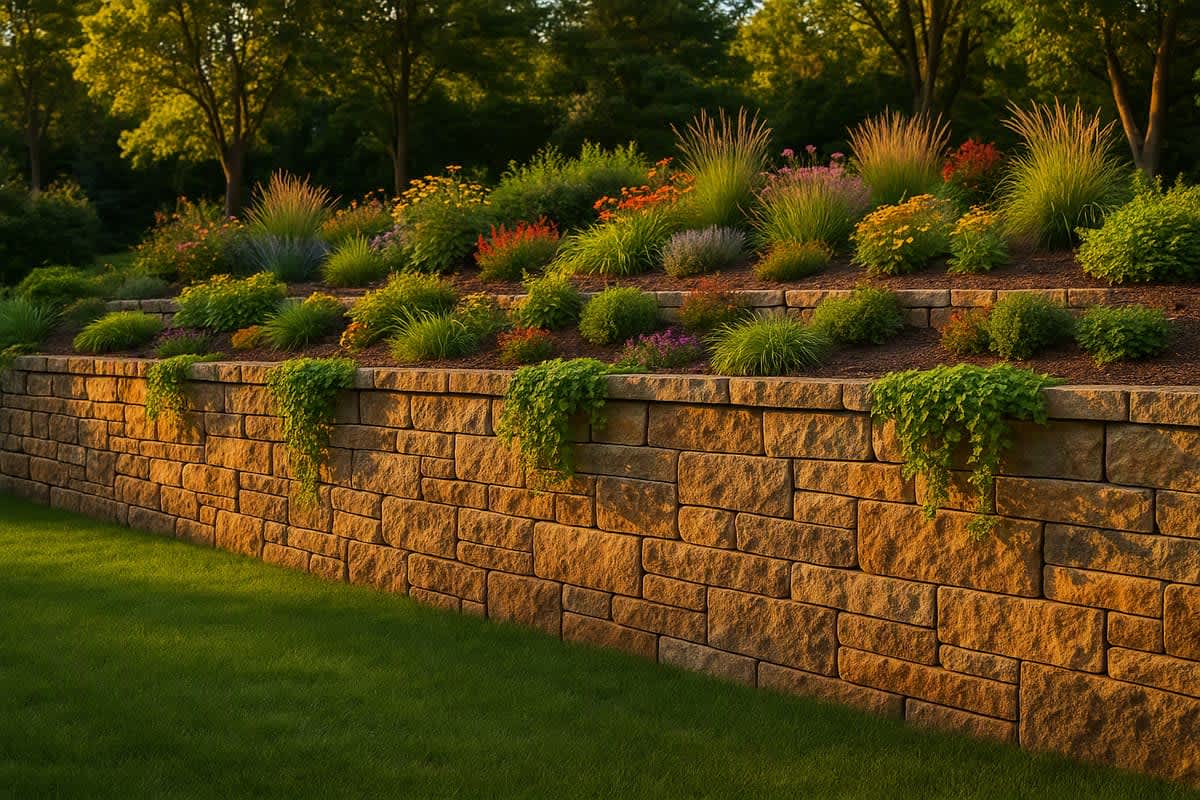
How much does a stone retaining wall cost?
How much does a stone retaining wall cost?
$2,000 – $10,000 average total cost
$10 – $85 per square foot
$20 – $340 per linear foot

Average stone retaining wall cost
A stone retaining wall costs $10 to $85 per square foot installed, with most homeowners spending $2,000 to $10,000 total for a wall that is 50 feet long and 2 to 4 feet tall. The national average cost is roughly $6,000. Prices vary widely based on the type of stone, wall height, site conditions, and whether the wall requires engineering.
Stone retaining walls are among the most durable and visually appealing options for managing slopes, preventing soil erosion, and creating usable outdoor space. While they tend to cost more than timber or basic concrete block walls, natural stone can last 40 to 100 years with minimal maintenance.
| Cost metric | Average cost |
|---|---|
| National average total cost | $6,000 |
| Typical total range (50' x 2'–4') | $2,000 – $10,000 |
| Cost per square foot | $10 – $85 |
| Cost per linear foot (2'–4' tall) | $20 – $340 |
| Low-end project | $1,000 |
| High-end project | $17,000+ |
Stone retaining wall cost per foot
Stone retaining walls cost $20 to $340 per linear foot for walls 2 to 4 feet high, or $10 to $85 per square foot. The wide range reflects differences in stone type, construction method, and wall height. Linear foot pricing is useful when comparing quotes because it accounts for both height and length in a single number.
To calculate square footage, multiply the wall's visible face height by its length. For example, a wall that is 4 feet tall and 25 feet long equals 100 square feet of wall face.
| Stone type | Cost per square foot | Cost per linear foot (2'–4' tall) |
|---|---|---|
| Gabion (wire cages with rock fill) | $10 – $40 | $20 – $160 |
| Dry-stacked stone | $20 – $85 | $40 – $340 |
| Boulder rock | $25 – $50 | $50 – $200 |
| Stone veneer over concrete | $30 – $80 | $60 – $320 |
| Natural stone (professionally built) | $90 – $150+ | $180 – $600+ |
Costs in major metro areas like Minneapolis can start at $65 to $90 per square foot for segmental block and $90 to $150+ per square foot for natural stone. Midwestern and Southern markets often see lower labor rates, with installed costs closer to $20 to $50 per square foot. Always get local estimates.
Cost by stone type
The type of stone you choose is the single biggest cost variable. Natural stone that requires hand-fitting costs significantly more than machine-cut blocks or boulders placed with an excavator. Here is how the most popular stone options compare.
| Stone type | Cost per sq ft (installed) | Lifespan | Best for |
|---|---|---|---|
| Gabion (rock-filled wire cages) | $10 – $40 | 10 – 75 years | Erosion control, shoreline stabilization |
| Fieldstone | $20 – $80 | 50 – 100 years | Rustic, natural look |
| Cobblestone | $20 – $45 | 50 – 100 years | Decorative garden walls |
| Keystone / Pavestone blocks | $20 – $55 | 50+ years | Budget-friendly, uniform appearance |
| Boulder rock | $25 – $50 | 100+ years | Walls under 4 feet, natural settings |
| Limestone blocks | $25 – $70 | 75 – 100 years | Clean, formal aesthetic |
| Slate | $30 – $85 | 75 – 100 years | Modern or contemporary landscapes |
Each stone type offers a distinct appearance and set of performance characteristics. The following sections break down the most common options in detail.
Boulder retaining walls
A boulder retaining wall costs $25 to $50 per square foot installed. Boulders are placed using a mini excavator, which means the property needs machine access. These walls rely on gravity alone, requiring no mortar, concrete footings, or separate drainage system. They work best for walls under 4 feet tall.
Boulder walls take up more horizontal space than block or dry-stack walls because each stone is naturally irregular. The tradeoff is a dramatic, natural appearance that blends well with wooded and rustic landscapes.
Dry-stack stone retaining walls
A dry-stack stone retaining wall costs $20 to $85 per square foot installed. This method stacks flat or semi-flat stones without mortar, relying on gravity and careful fitting to hold the wall together. Dry-stack walls allow water to seep through joints naturally, reducing hydrostatic pressure buildup.
Because each stone must be selected and hand-fitted, labor is the primary cost driver. A wall built from locally sourced fieldstone will cost much less than one built with imported slate or limestone.
Gabion retaining walls
A gabion retaining wall costs $10 to $40 per square foot installed. Gabion walls use rectangular wire cages filled with rip rap, river rocks, or crushed concrete. They install quickly, drain naturally, and adapt well to shifting ground.
Landscaping rock for gabion fill costs $45 to $130 per ton. Gabion walls are especially popular near shorelines and in areas prone to flooding because their permeable structure handles water flow without undermining the wall's integrity.
Stone veneer retaining walls
A stone-veneer retaining wall costs $30 to $80 per square foot. This approach uses a poured concrete or concrete block structural wall with a thin layer of natural stone applied to the visible face. You get the appearance of a solid stone wall at a lower cost than full-depth natural stone construction.
Stone veneer is a strong option when you need engineering-grade structural strength but want the premium look of natural stone. The veneer itself adds $10 to $25 per square foot on top of the base wall cost.
Cost by wall height
Wall height directly affects cost because taller walls need deeper footings, more material, geogrid reinforcement, and often engineering stamps and building permits. A wall that doubles in height more than doubles in cost.
| Wall height | Cost per sq ft (installed) | Typical total (50' long) | Notes |
|---|---|---|---|
| Under 2 feet | $10 – $35 | $1,000 – $3,500 | Garden borders, no permits needed |
| 2 to 3 feet | $20 – $50 | $2,000 – $7,500 | Most common residential size |
| 3 to 4 feet | $30 – $65 | $4,500 – $13,000 | May require permits in some areas |
| 4 to 6 feet | $45 – $85 | $9,000 – $25,500 | Engineering and permits typically required |
| Over 6 feet | $65 – $150+ | $19,500 – $45,000+ | Structural engineering mandatory |
Most jurisdictions require a building permit and a stamped engineering design for retaining walls over 4 feet tall. Engineering fees alone typically run $500 to $2,000, and permit costs add another $100 to $500 depending on your municipality.
If your slope requires a wall taller than 6 feet, two or three shorter terraced walls are often more cost-effective and structurally sound than a single tall wall. For example, two 3-foot walls with a planting area between them can cost less than one 6-foot wall that needs heavy engineering.
Cost by project type
The scope and purpose of your retaining wall project plays a major role in the final price. Small decorative garden walls involve minimal site work, while large structural walls and multi-level terracing systems require extensive excavation, drainage, and engineering.
| Project type | Typical cost | Details |
|---|---|---|
| Garden or landscape wall (under 3') | $2,000 – $6,000 | Defines planting beds, adds visual structure |
| Structural slope wall (3'–5') | $6,000 – $15,000 | Holds back significant soil, geogrid reinforcement |
| Multi-level terraced walls | $12,000 – $25,000+ | Two or three tiered walls stepping up a steep grade |
| Retaining wall replacement | $75 – $120 per sq ft | Demolition of old wall, new drainage, rebuild |
| Minor retaining wall repair | Under $1,500 | Resetting stones, patching, surface drainage fixes |
Garden and landscape walls
A stone garden retaining wall costs $2,000 to $6,000 for a wall under 3 feet tall and 20 to 40 feet long. These walls create terraced planting areas, separate lawn from garden beds, and add structure to a gently sloping yard.
A typical installation includes a compacted gravel base (6 to 8 inches deep), drainage aggregate and perforated pipe behind the wall, capstones for a finished top edge, and basic grading.
Structural slope walls
A structural stone retaining wall costs $6,000 to $15,000 for walls 3 to 5 feet tall and 30 to 60 feet long. These walls do real structural work: holding back soil that threatens foundations, creating level patio areas, or stabilizing steep grades.
Structural walls require a deeper compacted base (10 to 14 inches), geogrid reinforcement layers, a full drainage system with filter fabric and perforated pipe, and often an engineered design with a building permit.
Multi-level terraced walls
A terraced retaining wall system costs $12,000 to $25,000 or more for two or three tiered walls stepping up a steep hillside. Each tier is typically 2 to 4 feet tall with planting areas, walkways, or steps between levels.
Terraced systems involve significant earthwork, drainage behind each wall tier, landscape lighting, and connecting steps or pathways. Despite the higher total cost, terracing can be more affordable than building a single tall wall that requires heavy engineering.
Cost factors
Several factors beyond stone type and wall height influence your final cost. Understanding these variables helps you compare quotes accurately and avoid surprises.
| Cost factor | Impact on price |
|---|---|
| Site preparation and grading | $500 – $3,000+ |
| Drainage system | $5 – $15 per linear foot |
| Engineering and permits | $600 – $2,500 |
| Geogrid reinforcement | $3 – $8 per sq ft |
| Difficult site access | 10% – 25% cost increase |
| Curves and corners | 10% – 20% cost increase |
| Landscape lighting | $500 – $2,000 |
| Steps or built-in seating | $1,000 – $4,000 |
Site preparation
Clearing vegetation, removing old structures, grading the slope, and excavating for the wall's footing can add $500 to $3,000 or more to the project. Steep slopes, rocky soil, and limited equipment access all increase site prep costs. For larger projects, excavation and grading is often the first major expense before wall construction begins.
Drainage
Every retaining wall needs drainage to prevent hydrostatic pressure from pushing the wall over. A standard drainage system includes compacted drainage aggregate, filter fabric, and a perforated pipe at the wall's base. Expect to add $5 to $15 per linear foot for proper drainage. Skipping this step is the most common reason retaining walls fail. For more complex drainage needs, a French drain system behind the wall can provide additional protection.
Engineering and permits
Walls over 4 feet tall require a stamped engineering design in most municipalities. Engineering fees run $500 to $2,000, and building permits cost $100 to $500. Some jurisdictions require permits for any wall over 30 inches. Check local codes before starting your project.
Design complexity
Straight walls are the most affordable to build. Curves, corners, built-in steps, seating areas, and integrated planters each add 10% to 20% to the total cost. These features require more cutting, fitting, and labor, but they can significantly enhance functionality and curb appeal. Adding landscape curbing along adjacent beds can complement the finished wall and define planting areas.
DIY vs. professional installation
Building a small stone retaining wall under 3 feet tall is a feasible DIY project for experienced homeowners. However, walls taller than 3 feet, walls on steep slopes, or walls near structures should always be professionally installed.
| Approach | Cost range (50' wall, 2'–3' tall) | Considerations |
|---|---|---|
| DIY | $800 – $3,000 (materials only) | Suitable for low garden walls; requires tools, physical labor, and drainage knowledge |
| Professional installation | $2,000 – $10,000 | Includes labor, equipment, drainage, base prep, and warranty |
DIY savings are typically 40% to 60% of the installed cost because you eliminate labor charges. Stone materials alone cost $10 to $25 per square foot. You will also need to rent or buy a plate compactor, level, and possibly a small excavator.
Professional installation is recommended for walls that retain significant soil loads. A poorly built retaining wall can fail, causing property damage, drainage problems, and costly rebuilds. Contractors also carry insurance and typically warranty their work for 1 to 5 years.
A failed retaining wall can release tons of soil and debris. Walls over 4 feet tall should always be designed by a licensed engineer and built by an experienced contractor. Permit requirements exist to protect your property and your neighbors.
Frequently asked questions
What is the cheapest stone for a retaining wall?
Gabion retaining walls filled with rip rap or crushed rock are the least expensive stone option at $10 to $40 per square foot. For traditional stacked stone, locally sourced fieldstone and cobblestone are typically the most affordable at $20 to $45 per square foot. Using pea gravel as backfill behind the wall is also a cost-effective way to improve drainage.
How long does a stone retaining wall last?
A properly built stone retaining wall lasts 40 to 100+ years. Boulder walls and dry-stack stone walls with good drainage can last a century or more. Gabion walls have a shorter lifespan of 10 to 75 years depending on the wire cage material. By comparison, timber retaining walls last only 15 to 20 years.
Do I need a permit for a stone retaining wall?
Most jurisdictions require a building permit for retaining walls over 4 feet tall. Some areas set the threshold at 30 inches. Walls that affect drainage, sit near property lines, or support surcharges (driveways, structures) may also need permits regardless of height. Always check with your local building department before beginning work.
Is natural stone more expensive than concrete block?
Yes. Natural stone retaining walls typically cost $20 to $85 per square foot compared to $20 to $35 per square foot for segmental concrete block. The premium comes from both higher material costs and the hand-fitting labor that natural stone requires. Concrete block remains the most cost-effective option for most residential retaining walls.
How much does it cost to replace a stone retaining wall?
Retaining wall replacement costs $75 to $120 per square foot of wall face. Replacement runs higher than new construction because the failed wall must be demolished and removed before rebuilding. Most wall failures in freeze-thaw climates stem from inadequate drainage, hydrostatic pressure, or undersized footings, requiring a full rebuild rather than a simple repair.
Does a stone retaining wall add property value?
A well-built stone retaining wall increases usable yard space, prevents erosion, protects foundations, and enhances curb appeal. While the exact return on investment varies by market, retaining walls that solve functional problems (such as unusable slopes or foundation drainage issues) are considered essential improvements rather than optional upgrades. Properties with well-maintained stone walls are consistently more attractive to buyers.